Three Months of ChatGPT Part III: Learning
Of all the uses that ChatGPT has, how it has helped me learn things is my favorite. Currently, I’m working on a second master’s degree in Data Science, and it has proved invaluable in helping me learn.
School Learning
I’m taking a course, CSCI 5260: Artificial Intelligence. This course uses a book called Artificial Intelligence: A Modern Approach. Because the newest edition of this book was written in 2022, ChatGPT doesn’t know it, but it does know the previous version of this book. Before I do my reading, I ask it to outline the chapter for me with the key points. I use this outline to fill in my notes. I’ll show you what this looks like.
[caption id="" align=“alignnone” width=“1420”]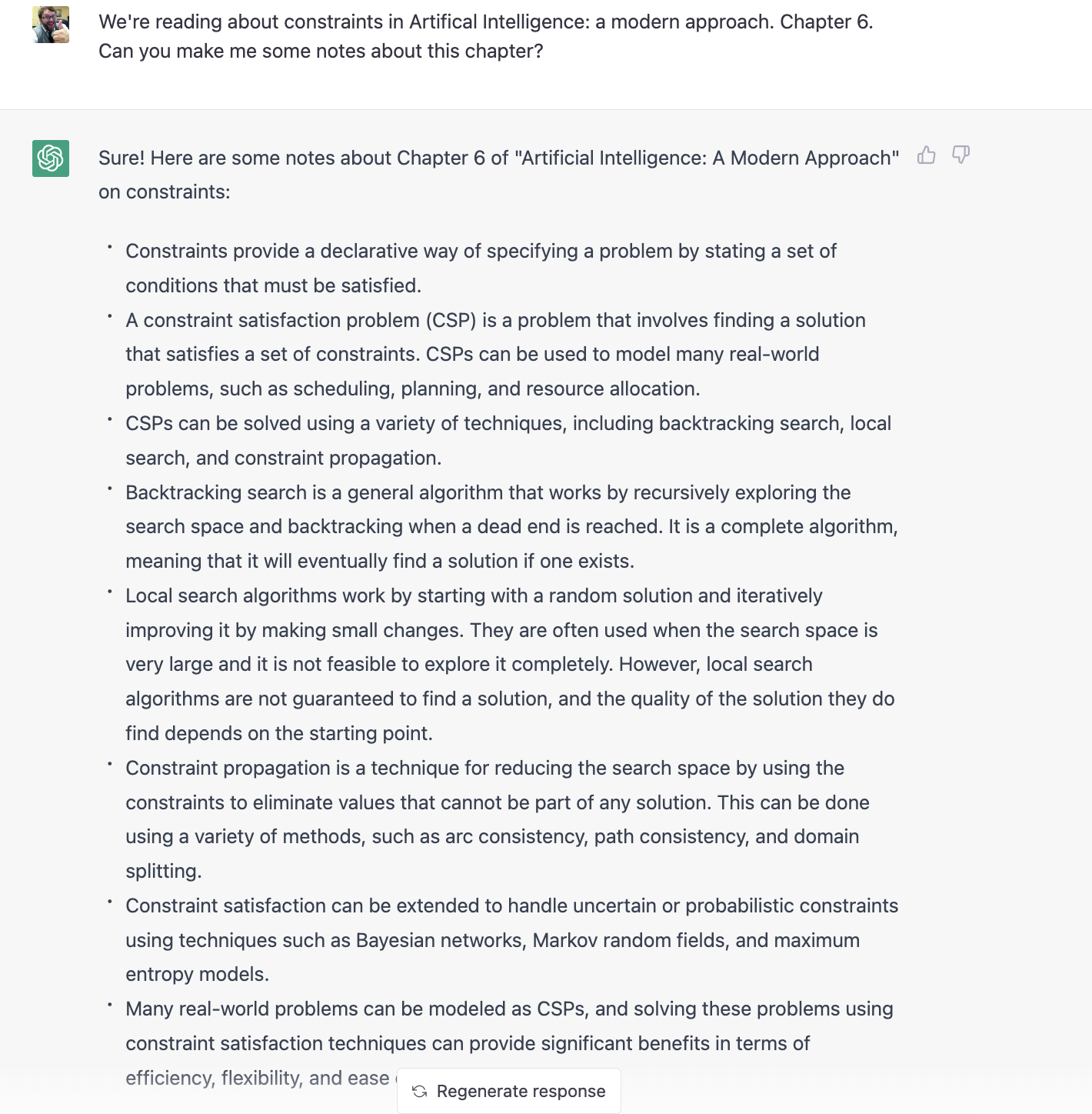 Reading Notes [/caption]
This really prepared me to read the chapter, and it also gives me a guide for taking notes.
Once my professor posts his PowerPoint, I export it to an RTF file, and I have it make an outline of it. This gives me something to use when I’m taking notes during his lecture. By the time his lecture is finished, I have my notes from the book and notes from him, and I have the ChatGPT chapter summary and PowerPoint summary. I take all of that information and put it back into ChatGPT, and I ask it to make a study guide. I use this study guide to help me take my open-notes quiz. Note that I’m not taking any shortcuts here; I’m only deepening my learning by using ChatGPT to do the part that nobody has time for (making summaries and study guides).
A potential shortcut to this would be to record the audio of the lecture, and use a voice to text program to submit that straight into ChatGPT, but I’m not there yet. Those are some extra steps that could keep me from even having to take notes, but I find that taking notes improves my understanding.
During lectures, if the professor is explaining something that’s out of my depth, I ask ChatGPT to explain it to me. Here is an example from my last class.
[caption id="" align=“alignnone” width=“1728”]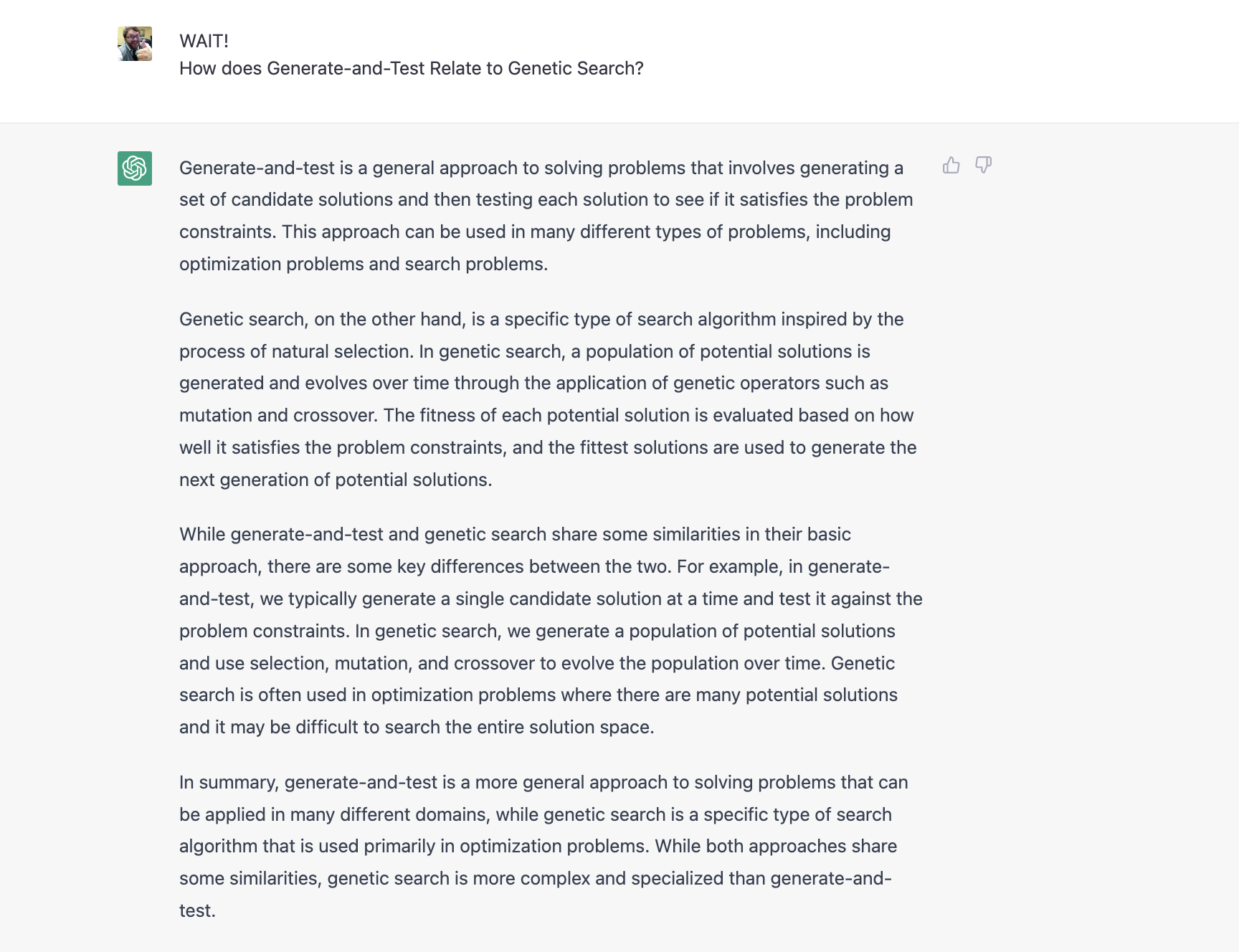 Explaining Something [/caption]
As you can see, I didn’t really understand how these two types of search were related, and ChatGPT explained it to me. So far, I’ve only shown you examples from a graduate-level Computer Science course.
Let’s see how it could help a third-grade student understand fractions.
[caption id="" align=“alignnone” width=“1510”]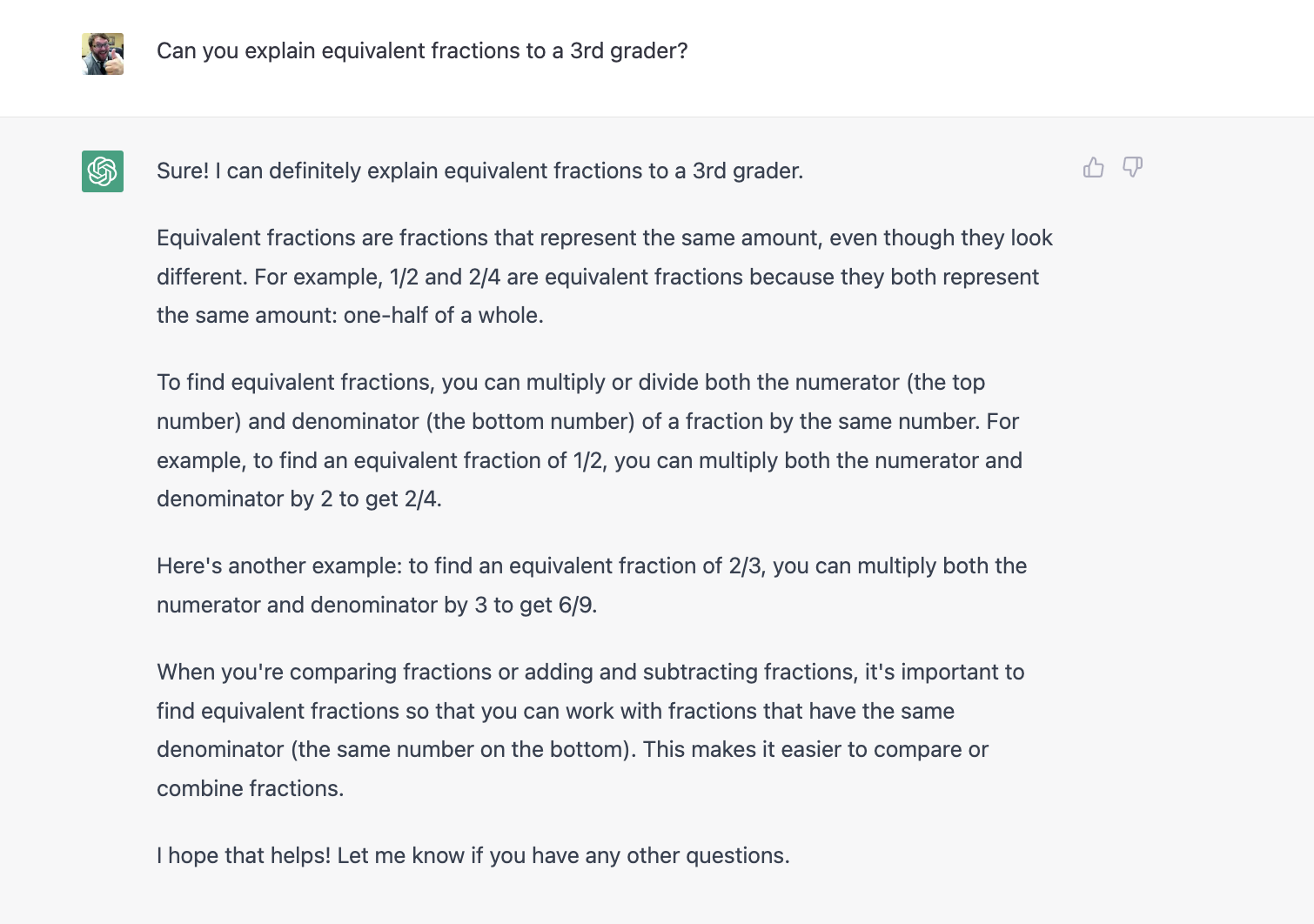 Explain Equivalent Fractions to a Third Grader [/caption]
Or if you need help helping them, it can suggest that, too.
[caption id="" align=“alignnone” width=“1464”]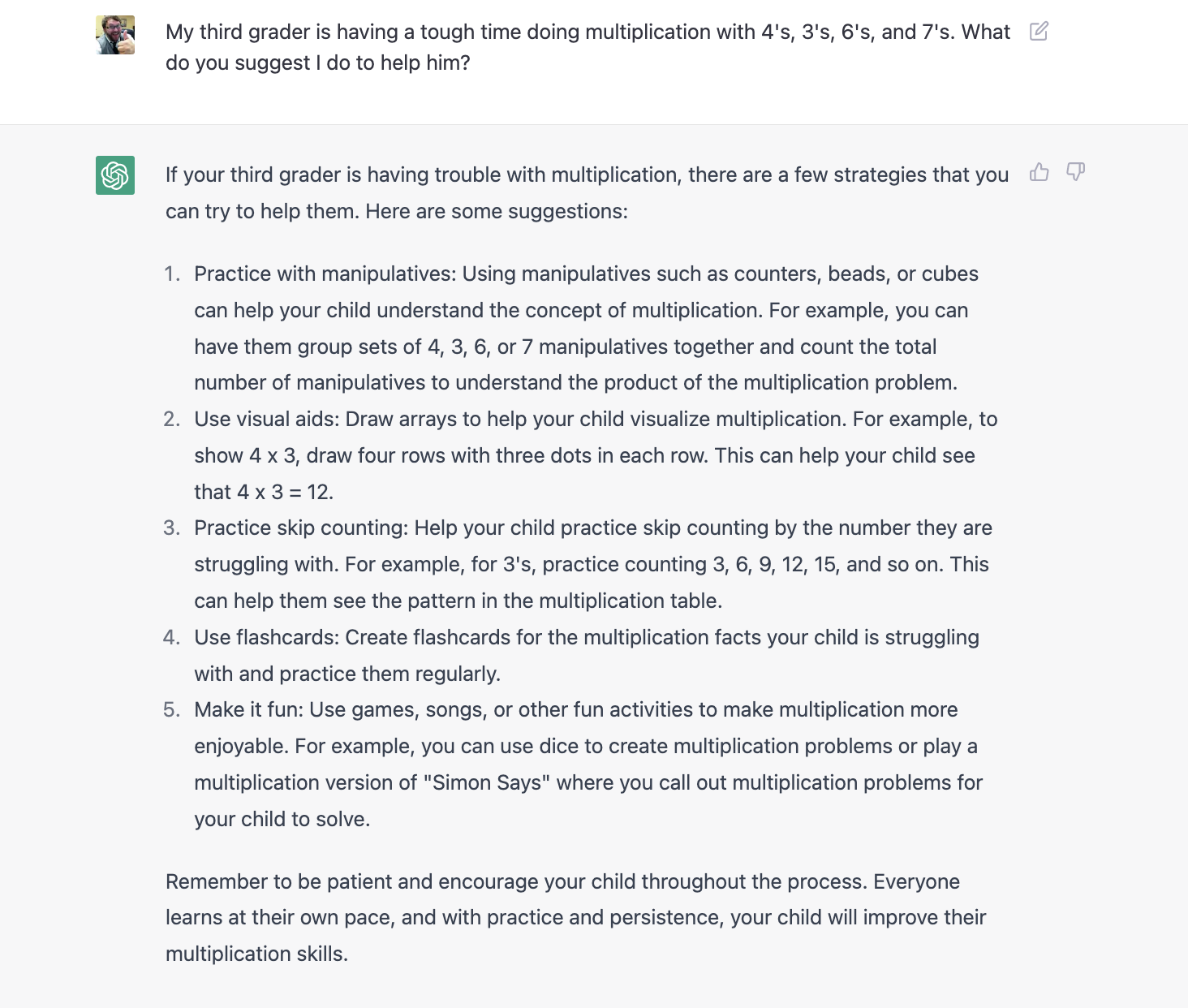 Help a Third-Grader [/caption]
What about high school stuff?
Let’s see how it does with something that nearly everyone has to learn. I’m going to let the whole thing play out.
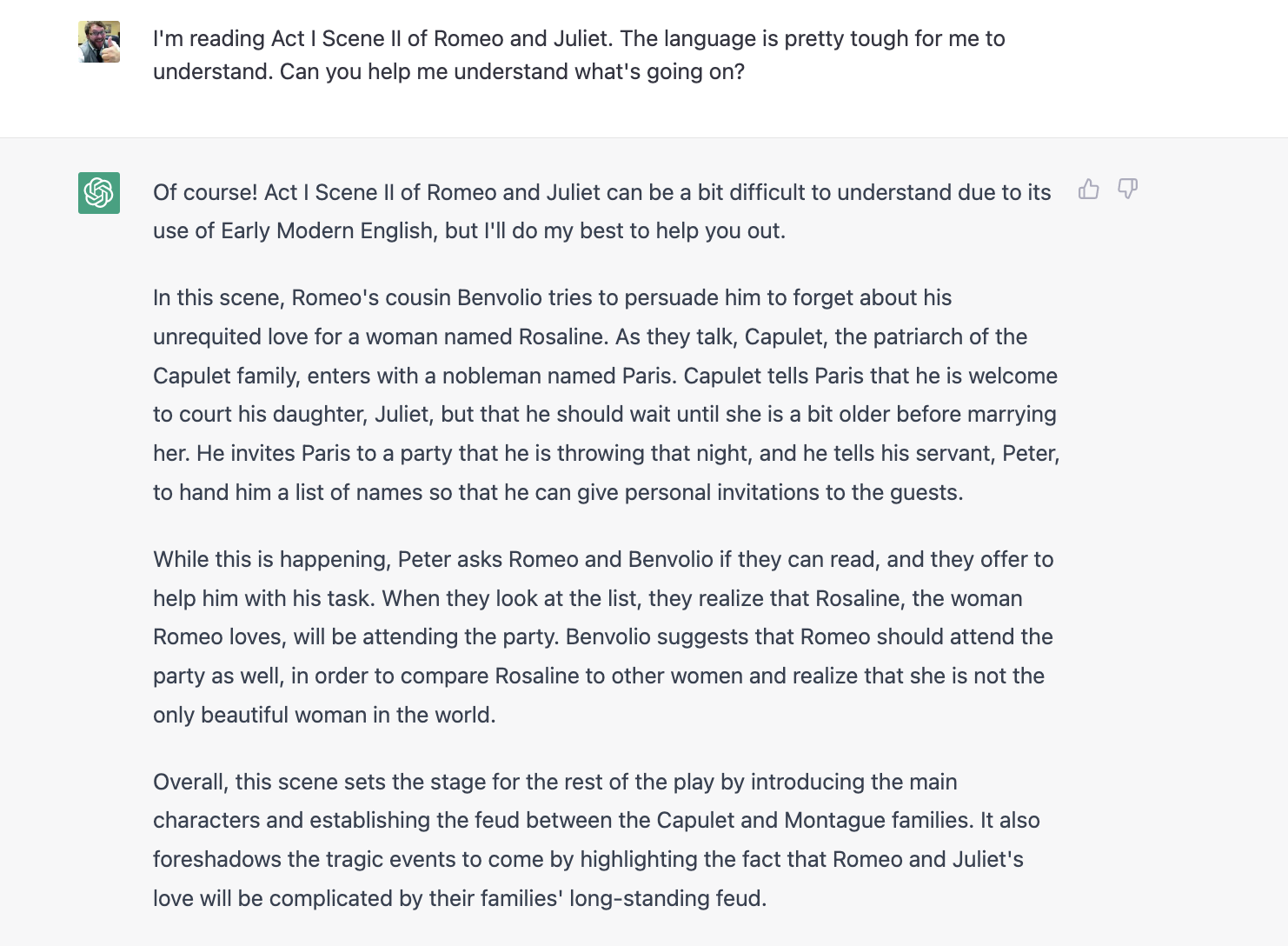
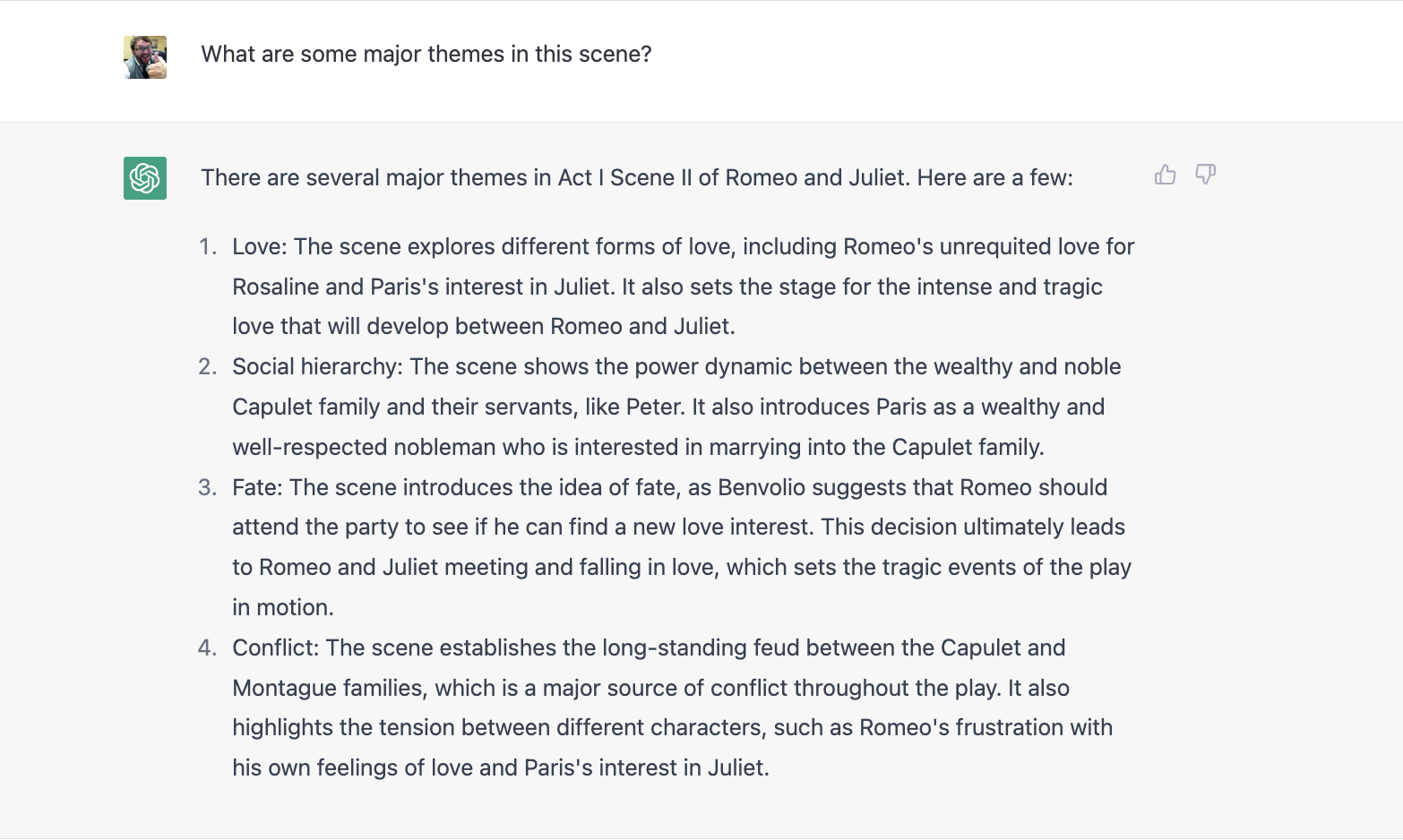
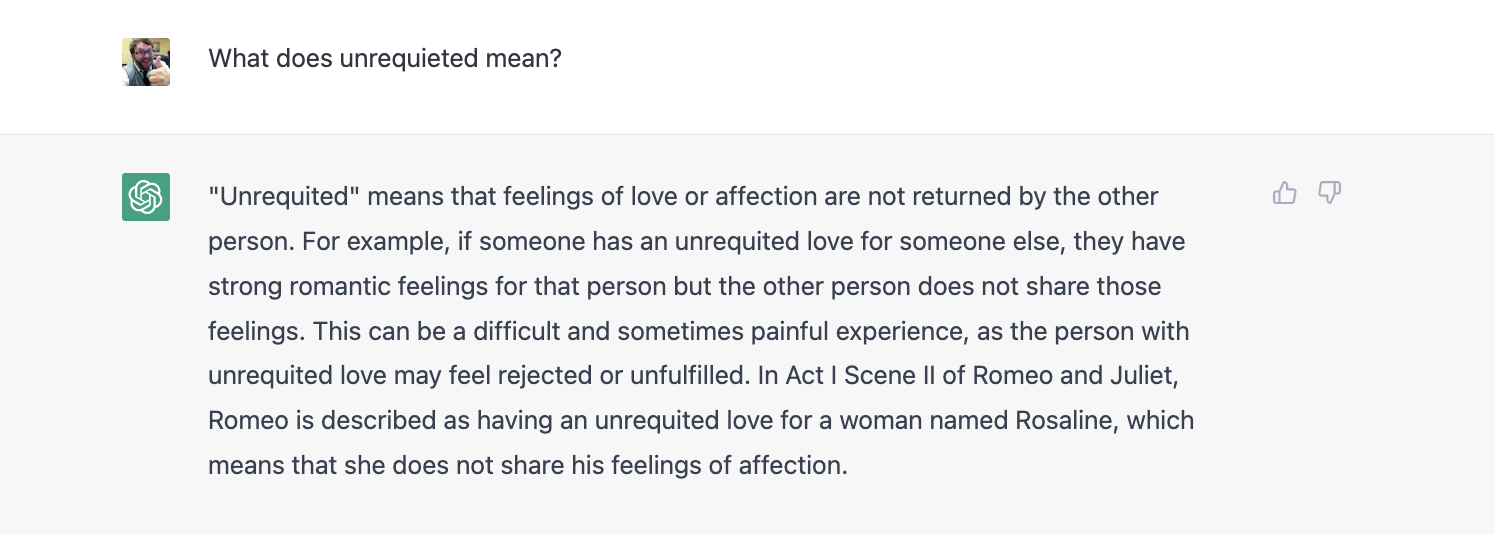
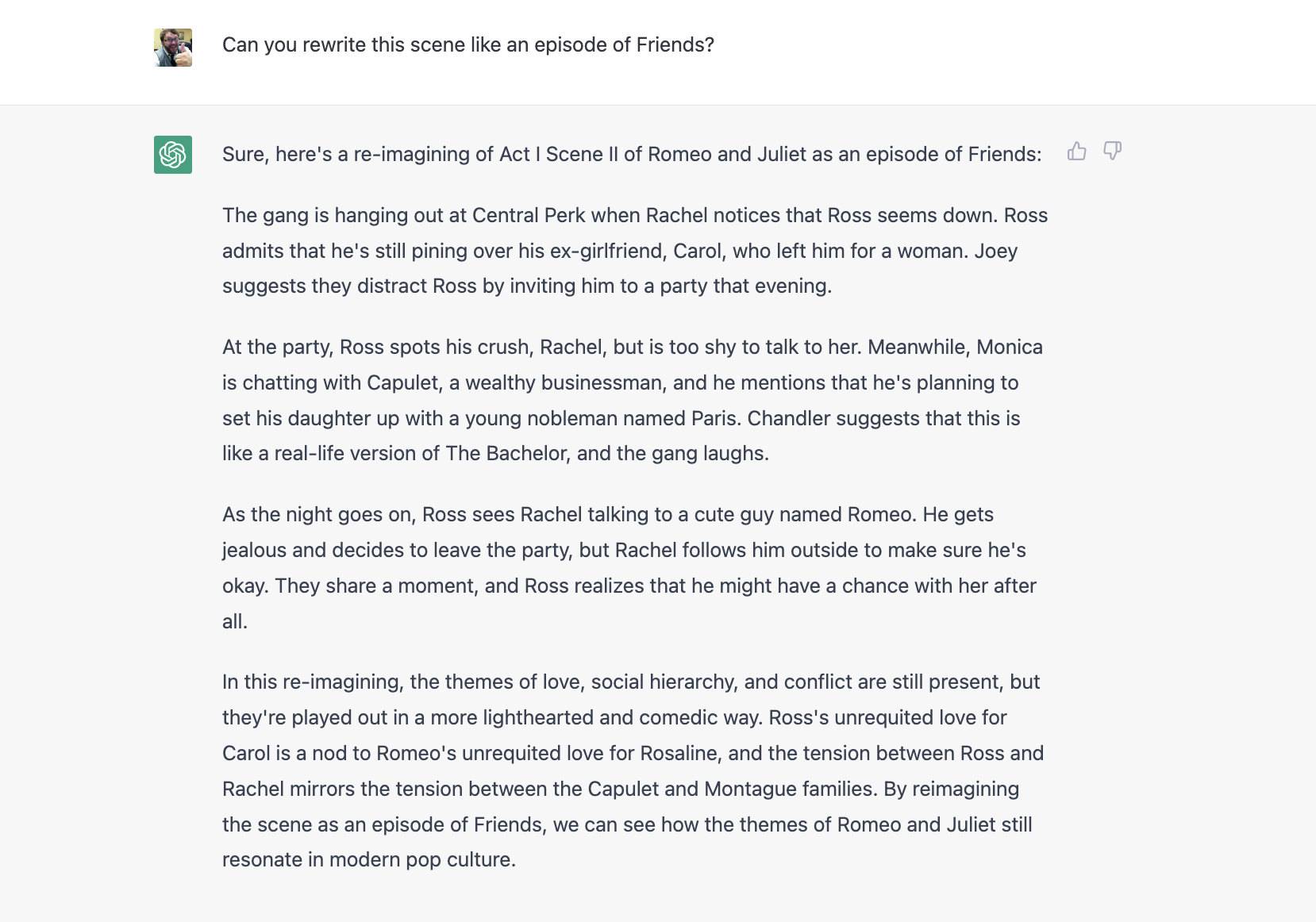
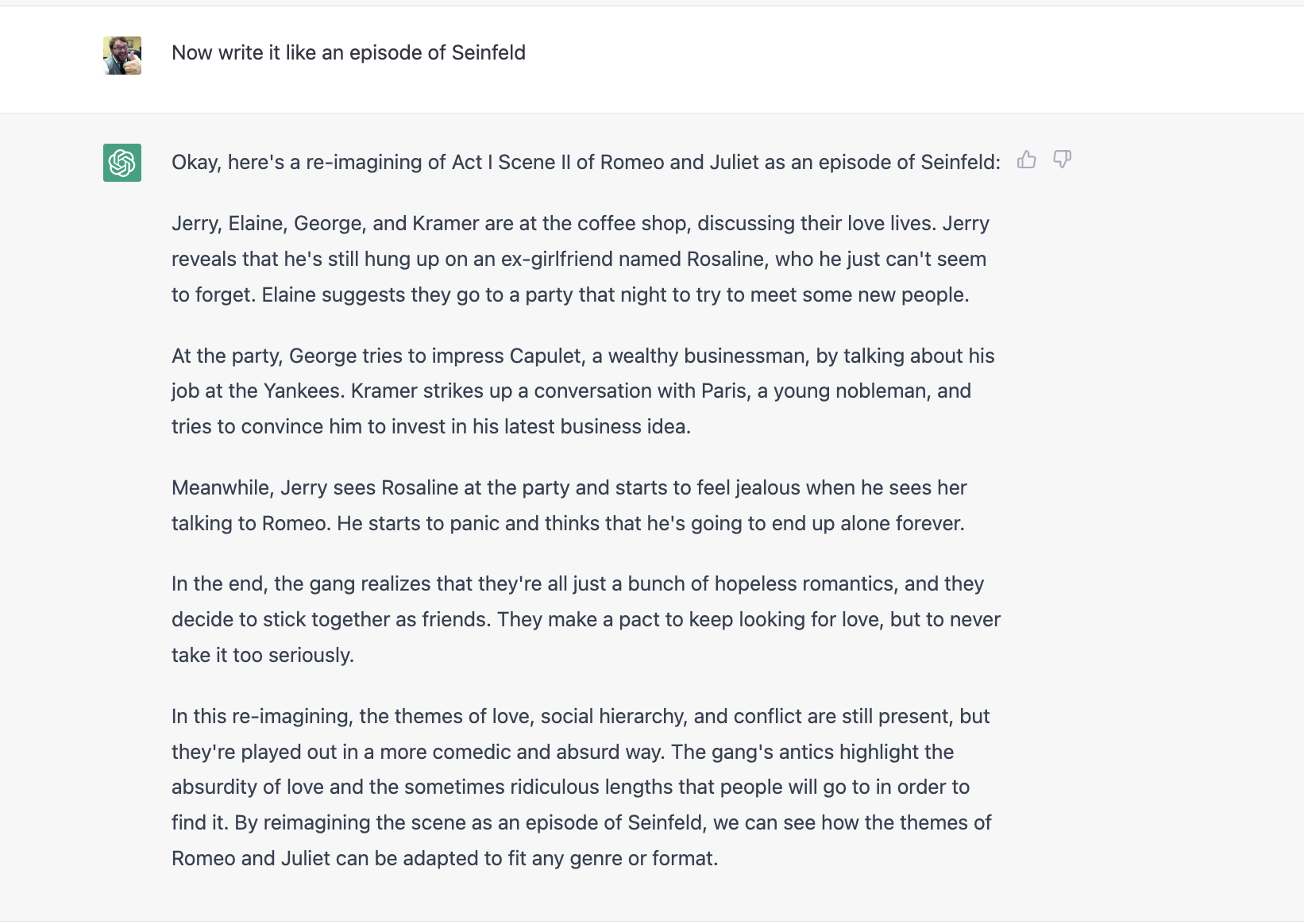
A freshman reading Romeo and Juliet for the first time could benefit from having ChatGPT within reach rather than just struggling through the text and giving up on it. This is just like Cliff’s notes, except you can interact with it and if throws a word at you, just ask what it means. Instead of getting a dictionary definition, it will tell you what the word means in context.
Also, you can get loopy and ask it to rewrite the scene as if it’s an episode of Seinfeld or Friends just for fun.
Coding
I’m in two different classes that require me to use Python to do my work. One, CSCI 5010: Programming for Data Analytics, is basically an intro to Python class. I don’t use ChatGPT for help in it much because it’s designed for us to go through several steps to learn how to code with Python. If I used ChatGPT for that, I would never learn the basic code, and it would really stunt my growth in Python. The usefulness of ChatGPT is highly dependent on the user’s level of knowledge, as it becomes increasingly powerful for those who are knowledgeable and relatively useless for those who lack knowledge. I am not going to be able to use it for advanced coding if I make it do my simple coding, too. Having given that disclaimer, the coding required in CSCI 5260 is much more complex than the coding in 5010, and I have used ChatGPT several times to explain what’s going on in the code so that I can learn more and understand it. Here is an example:
[caption id="" align=“alignnone” width=“1796”]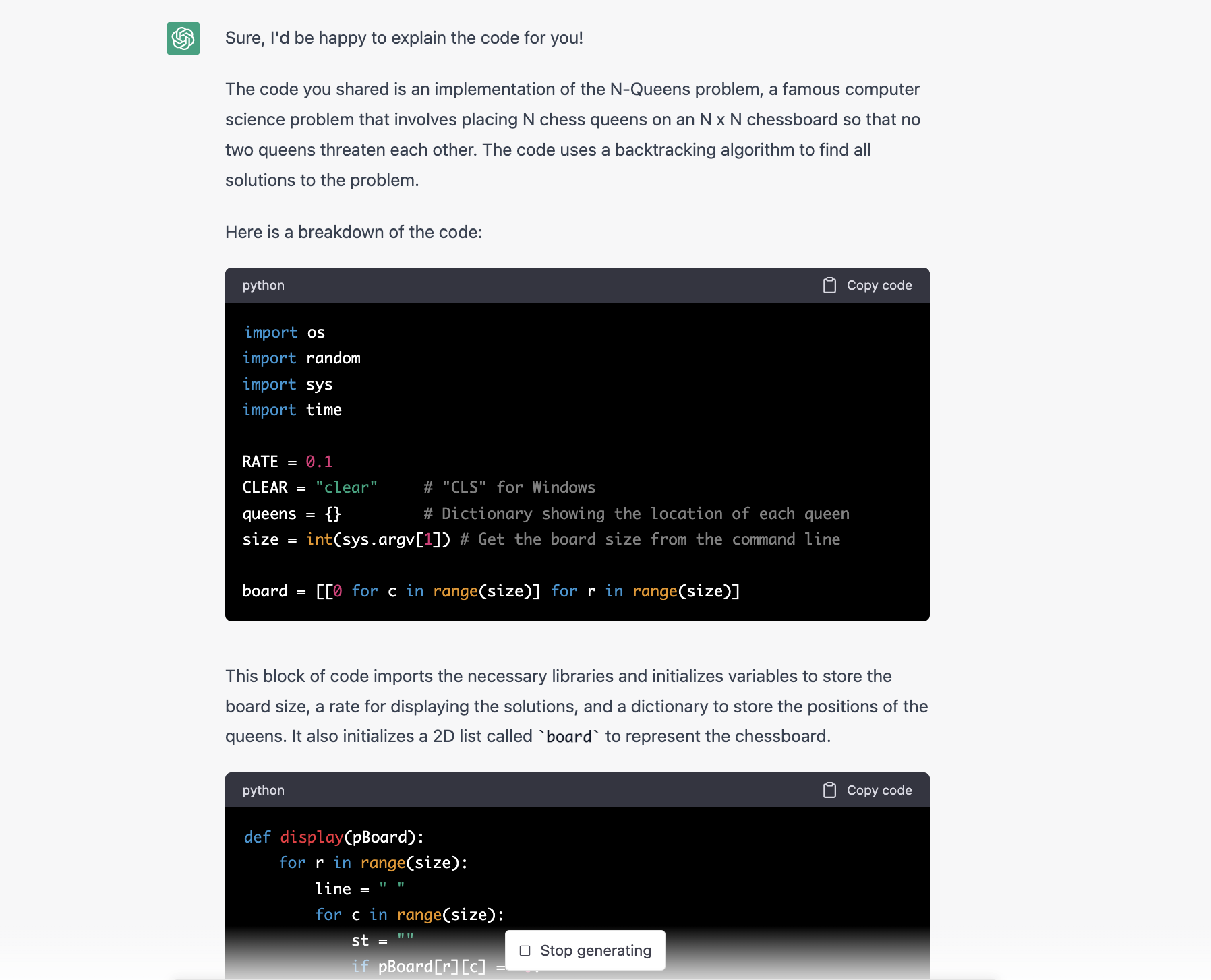 Analyzing Code [/caption]
And if your code gets an error message, you can ask it to explain the error message to you, and it will even suggest code to fix it.
[caption id="" align=“alignnone” width=“1748”]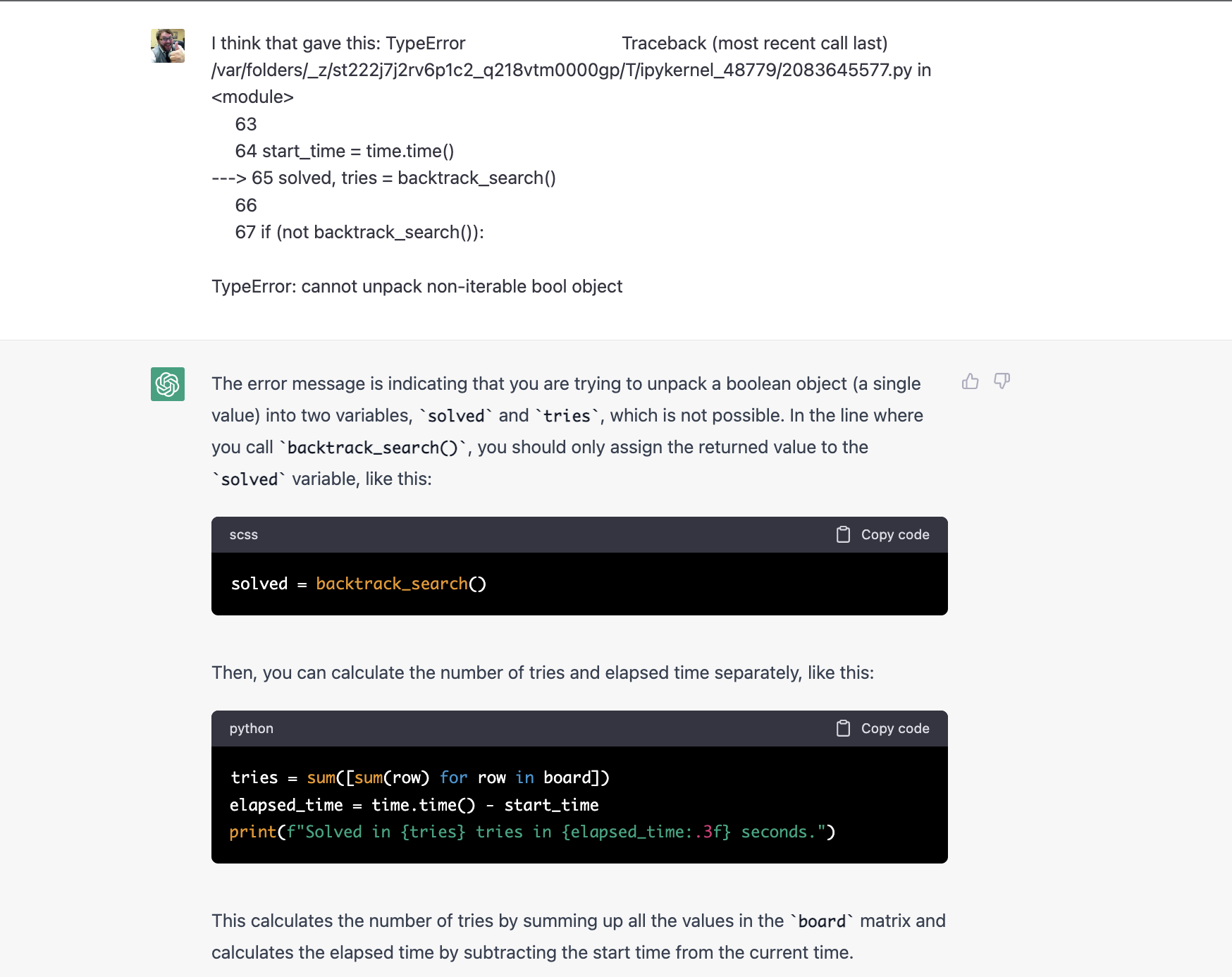 ChatGPT Fixing a Problem [/caption]
It isn’t limited to Python, of course. You can have it write in other languages. This could be very helpful with HTML. For example, if I wanted to write some HTML code to insert into my site that has a LOOK AT THIS HTML in big letters using a cursive font, I could just ask ChatGPT how to do that.
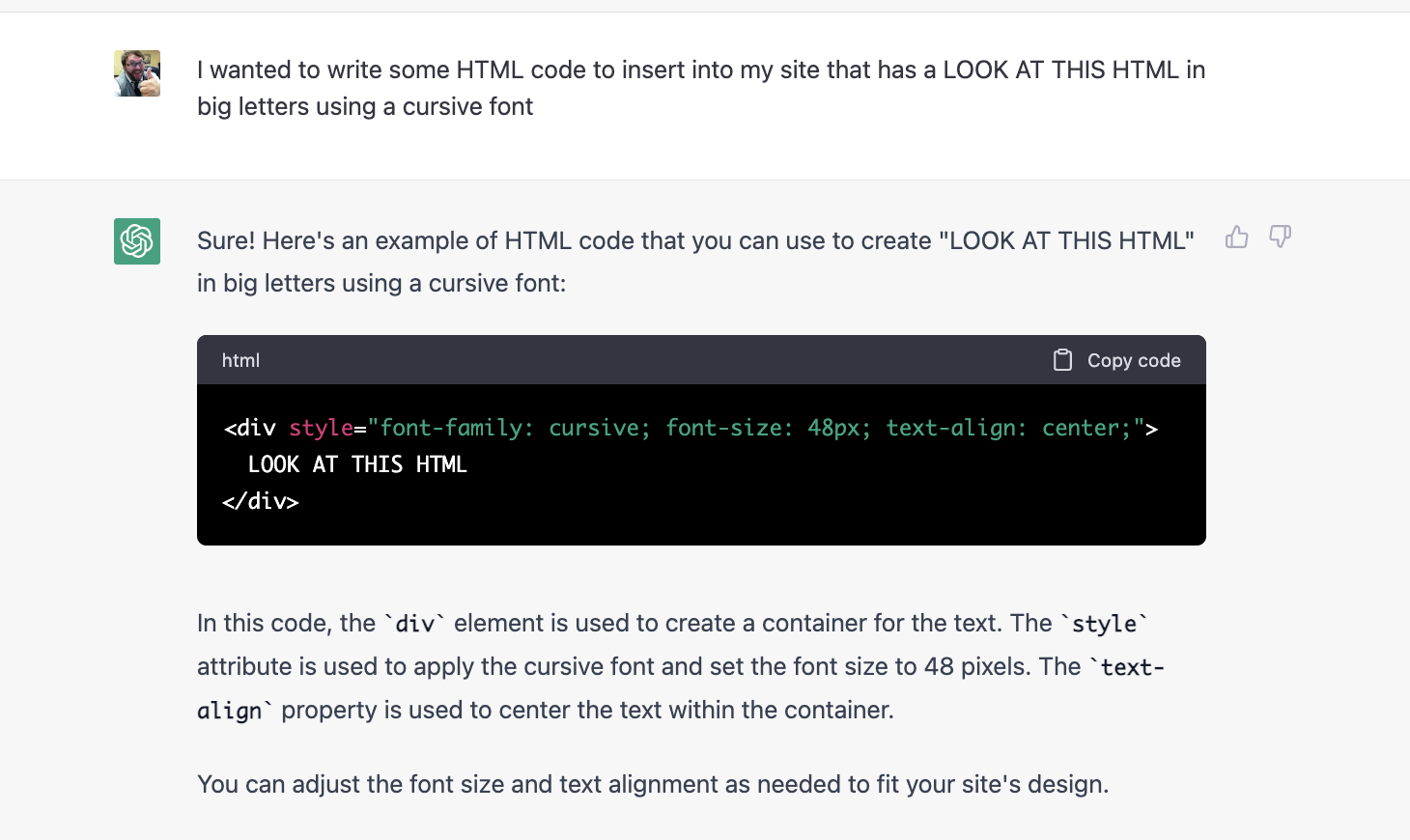
If we only had this back in the MySpace days.
For the uninitiated, how everyone has fixed their code for the past two decades is to go to sites like GitHub, StackOverflow, or just Googled it. This would rarely produce a 1:1 fix for your code. You would have to extrapolate how to fix your own code from someone else’s code fixing something adjacent. And while that was always a pretty decent learning experience, it just doesn’t compare to having ChatGPT look at your code for you. The more you talk to it about what you’re trying to accomplish, the more precise it is with your code.
Laws and Policies
I would not use ChatGPT in place of hiring an attorney, but sometimes you just need to understand what a law means. Let’s say you’re watching TV and someone pleads the fifth. Let’s see what ChatGPT says about that.
[caption id="" align=“alignnone” width=“666”]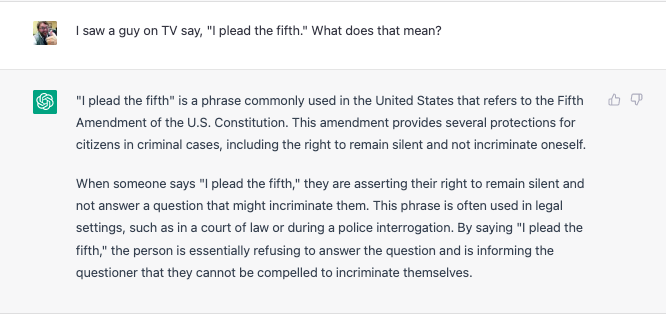 I plead the fifth [/caption]
Maybe you want to figure out how that go into the Bill of Rights in the first place.
[caption id="" align=“alignnone” width=“762”]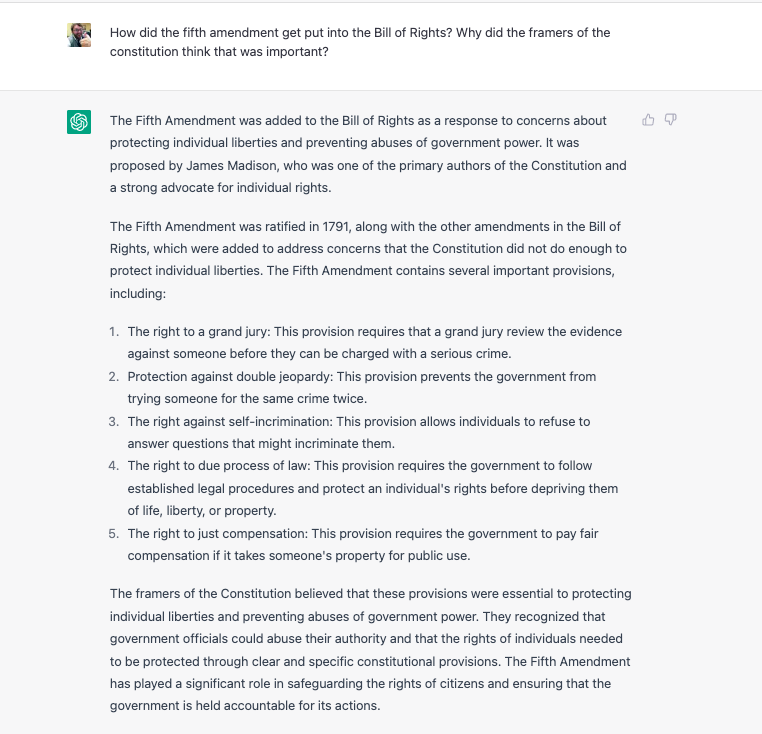 Still Pleading the Fifth [/caption]
Let’s dig even deeper. Let’s say you’re a big Hamilton fan and want to see what Hamilton wrote about The Fifth Amendment in the Federalist Papers.
[caption id="" align=“alignnone” width=“779”]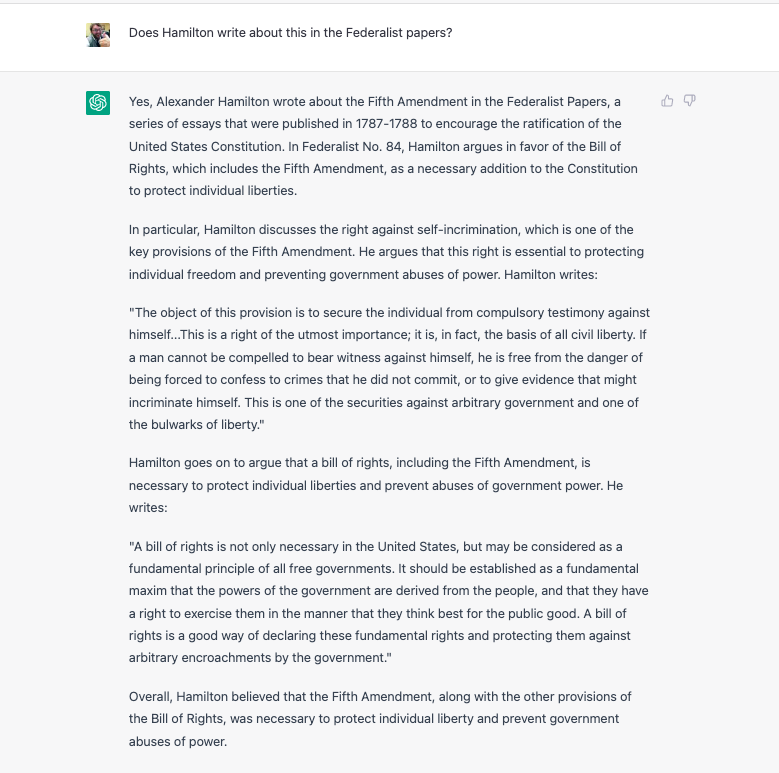 Hamilton Pleads the Fifth [/caption]
I wonder if there are any exceptions to the Fifth Amendment.
[caption id="" align=“alignnone” width=“757”]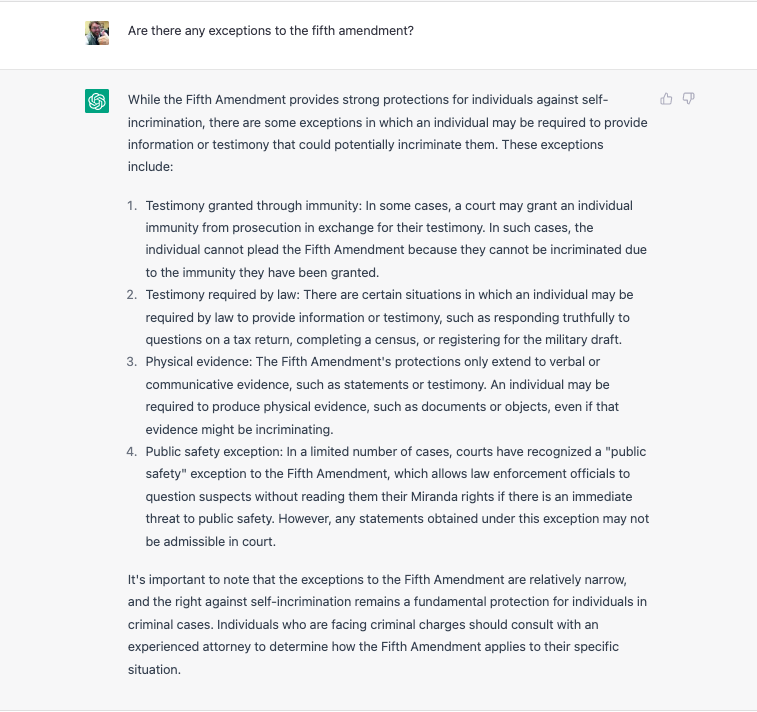 Exceptions to the Fifth Amendment [/caption]
This is all in one conversation that takes a minute or two to do. And if you check it against the primary source or other sources, you can see that it stands up. I like how it includes quotes from the sources if you ask about it. For example, if you ask about the sources from the Federalist Papers, it’s going to include quotes. I would be cautious about using ChatGPT as a source, and I definitely wouldn’t ask it to tell you how to cite something. I asked it to cite the Federalist Papers in APA format, and here’s what happened. I had to correct it.
[caption id="" align=“alignnone” width=“775”]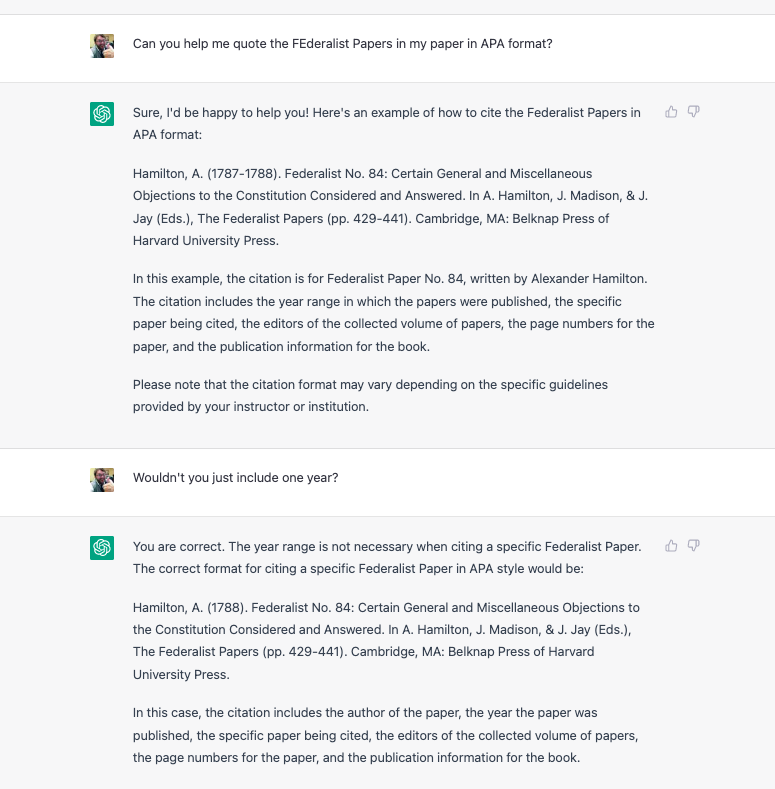 APA Oops [/caption]
Suggestions for Students
-
Understand that this is still in its infancy, but it is already a powerful tool that you need to know how to use.
-
Don’t trust it as a source any more than you would anything else, but it is reliable especially if you focus it to specific information that you want.
-
Try to get class materials into copyable text to put into to have it organize and analyze for you.
-
Tell it the name of your textbook and have it create guides for each chapter to make it easier to take notes on your reading.
-
Have it help you make study guides.
-
Feed your own typed notes into it and have it organize them for you.
-
Have it create a quiz for you and grade your responses. This works well if you give one response at a time.
-
If your professor provides you with a rubric, you can feed it into ChatGPT, and then paste your paper and have it evaluate your paper using the rubric. Ask it to give you feedback. This will be different than a human, but it will still be insightful.
-
Have it help you write emails to your teachers or professors that sound professional.
-
Have it proofread your papers for you. If you have it write it for you, then it will get caught in an AI detector. Just tell it to tell you where your mistakes are and put them in a table (it’s easier to keep track of them there).
-
Tell it to explain something complex to you like you’re ten years old if you don’t really understand it.
-
If you don’t understand something, tell it what you don’t understand about it.
-
Ask it to explain books to you and why they’re important.
-
Pretend it’s a friend who read the same book as you and talk to it like you’re hanging out discussing the book. If its tone is too impersonal, tell it to pretend it’s your friend.
-
If you are given an open-ended assignment, have it give you ideas on what you could do. (Think six-grade science fair.)
-
Have it help you brainstorm during the writing process.
-
Free write ideas and have it organize them for you.
That’s enough homework for now.